Breadcrumbs
- News
- News Archive
- Dominican Inspires Family Legacy

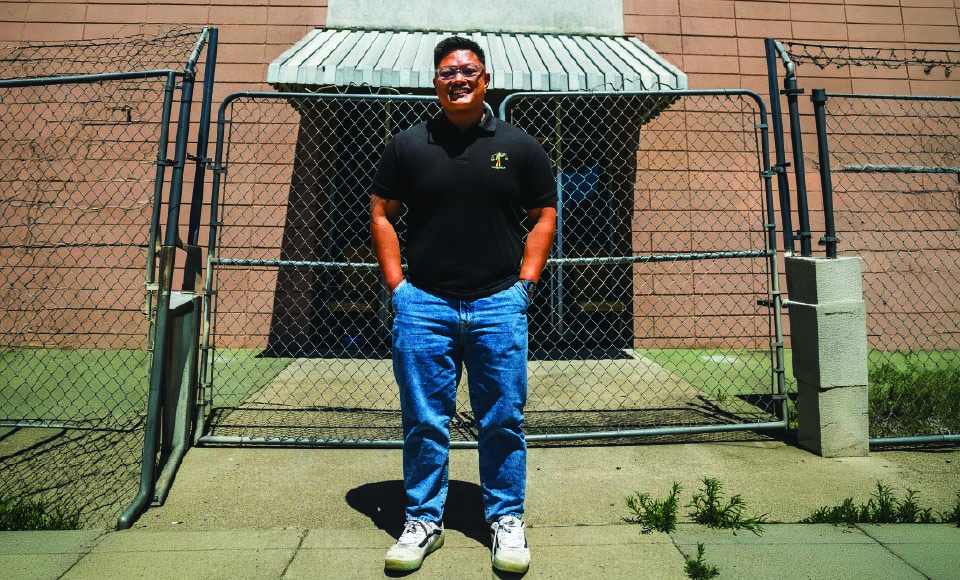
For Kevin Sunga '15, Dominican is family.
Not only is his wife, Elizabeth “Nikki” Chan-Sunga, a Dominican alumna, but several cousins also attended the university between 2012 and 2021. “Dominican is a family legacy,” Kevin says, referring to relatives Susana “Stacey” Cummings, Francis Sunga, Yvonne Bamba, Joanne Bamba, and Mirabella Mercado-Sunga, Francis’ spouse.
Most of Kevin’s cousins studied nursing at Dominican and now work in prestigious health centers. Kevin and Nikki took a different path and today are leaders in the nonprofit sector in California’s Central Valley.
Kevin serves as deputy director of Little Manila Rising, a place-based social justice nonprofit in Stockton. There, he works at the intersection of community development, historic preservation, health equity, environmental justice, and youth empowerment to benefit residents of South Stockton who have been historically redlined. Nikki is executive director of Empowering Marginalized Asian Communities, which practices community-based transformative justice to heal and prevent violence while advancing holistic liberation.
Kevin credits the rigor of his Dominican education with providing a strong foundation for his future career.
“I've spearheaded a fair amount of advocacy work, navigating and negotiating with legislative offices, state agencies, and philanthropic circles,” he says.
“What I took from my classes and coursework has translated more than I expected. It's been especially useful in staying creative and strategic in sustaining our movement during this challenging moment.”
A growing interest in history and government led Kevin to Dominican with a goal of one day working in politics.
“It was my senior year in high school that I became interested in how history and the powers that be shape policy,” he recalls.
A classmate at St. Patrick-St. Vincent High School recommended Dominican’s political science program, and after speaking with his cousin Stacey, Kevin knew he would find a supportive and welcoming community.
Initially, Kevin envisioned a career in a congressional office. As he gained a deeper understanding of the political system, however, he realized he wanted to work closer to home, where he could have a more direct impact on his community through local and state-level decision-making.
One person who played a pivotal role in Kevin’s journey was political science professor Alison Howard, who encouraged him to apply for a postgraduate fellowship through the University of San Francisco’s Leo T. McCarthy Center.
Selected as a McCarthy Fellow, Kevin gained firsthand exposure to California’s policymaking process. His placement with the California Department of Corrections and Rehabilitation introduced him to health policy in motion and sparked an interest that would shape the next stage of his career.
That interest led to a full-time position at UCSF Medical Center, where Kevin first worked as a clinic coordinator and later as a clinic supervisor, overseeing several oncology service units at Mt. Zion. Over the years, he took on a wide range of responsibilities, including helping facilitate expansion into UCSF’s Mission Bay and Redwood City campuses.
It was at UCSF that Kevin developed a passion for addressing inequities in healthcare.
“I became deeply engaged in patient advocacy — navigating insurance denials, coordinating care across regions, and ensuring patients had equitable access to care,” he says.
He also witnessed the barriers many patients faced.
“I worked with patients from the Central Valley whose only option was to drive to UCSF in San Francisco for treatment because there were no services available closer to home.”
The experience deepened his understanding of the disparities in healthcare access.
“UCSF is a great system,” he says, “but I realized it was a system that many marginalized communities had difficulty accessing.”
That passion for advocacy and community health ultimately led Kevin to Little Manila Rising, where, since 2021, he has worked on historic preservation, community development, health equity, and environmental justice initiatives.
His first role was co-developing the Equity in COVID and Health Outcomes program, which focused on COVID-19 response, vaccination outreach, and health education for marginalized communities in South Stockton. The initiative distributed 2,000 COVID-19 tests and supported more than 1,700 vaccinations.
Kevin later became director of grants and fiscal sustainability, fundraising $7 million for multiple initiatives before being named deputy director in June 2024, overseeing the organization’s environmental justice initiatives while leading grant strategy and fund development.
Kevin has contributed to several major milestones, including artifacts for the Smithsonian National Museum of American History exhibit “How Can You Forget Me?” He also helped secure financing for a $7 million renovation of the organization’s center, which will reopen next year as a Climate and Community Resiliency Center.
Today, Kevin continues to draw on lessons from his Dominican education as he helps shape programs focused on climate change, urban reforestation, community redevelopment, and anti-displacement strategies, allowing community wealth to flow without gentrifying communities.
He encourages current students to take full advantage of the opportunities available at Dominican.
“As I reflect on my own Dominican experience, I would advise students to embrace the rigor and take advantage of the low student-to-teacher ratio. This mirrors real life in terms of engagement and collaboration,” he says.
He also encourages students to remain open to unexpected opportunities.
“My journey was not linear,” he notes. “We all have hopes of where we want to land. For me, life has been so fun because I’ve moved in a nonlinear direction. I’ve embraced what has come in between.”
That journey into leadership has reinforced the importance of empathy. As he continues to grow in his career, Kevin remains inspired by a quote he often recites:
“Empathy is the most necessary trait for effective leadership, which requires one to perform all roles that lead up to that leadership position. To empathize, you have to live a day in their shoes. Take your time. Climb the ladder.”