Breadcrumbs
- News
- News Archive
- Service-Learning Students Working With Partners Across Marin

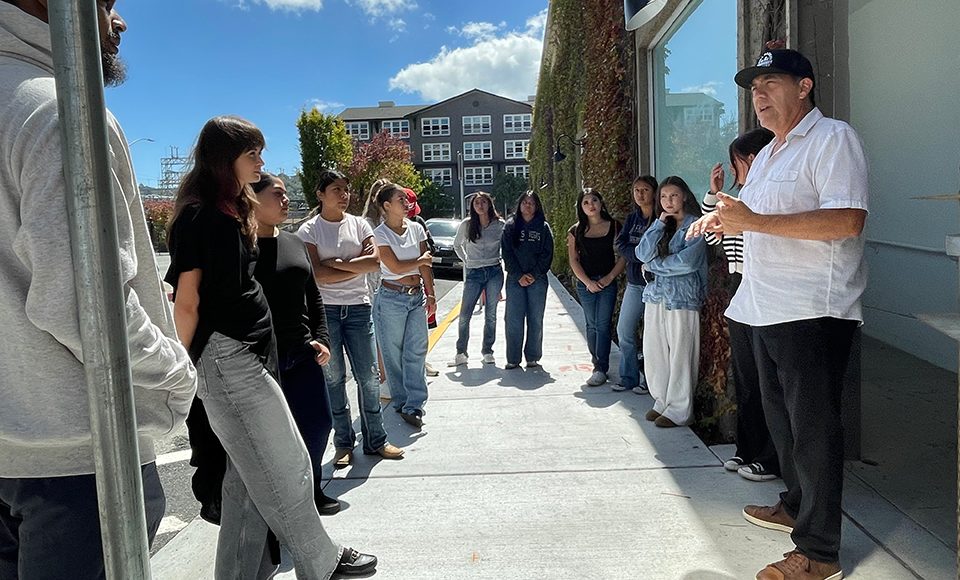
More than 130 undergraduates are supporting community organizations throughout Marin County this semester through Dominican University of California’s robust service-learning program.
Service-learning combines meaningful community work with classroom learning, focusing on critical reflection and local community engagement to help students understand the root causes of social issues. At Dominican, service-learning has been a critical component of the undergraduate program for 22 years, with more than 7,000 students engaging with the community through service-learning courses.
Each semester, community partners serve as co-educators, working alongside Dominican faculty to ensure the students both understand and address local needs. The work enhances community capacity, providing nonprofit agencies valuable resources and support for ongoing projects and initiatives. Meanwhile, students gain real-world skills like teamwork, problem-solving, communication and critical thinking.
This fall, service-learning is integrated into the curriculum of 13 academic courses in several majors. Offerings include the history department’s “Evolution of Human Cultures,” the honors program’s "Healthcare Ethics and Equity” course, and the philosophy program’s “Ethics of Citizenship and Immigration.”
Students are choosing their community partners this week, with a significant number of service-learners engaging with long-time partner the Ritter Center, a nonprofit that supports individuals and families facing housing insecurity, food insecurity and other challenges. Ritter Center is in the process of moving into a new, state-of-the-art health and wellness center in downtown San Rafael.
Ritter Center has hired several former service-learning students, including Sizi Rios ’25, says Julia van der Ryn, executive director of the Gilardi Center for Community Engagement & Partnerships and the Service-Learning program.
Sizi came to Dominican as a global public health major with a goal of serving her hometown community in San Rafael’s Canal neighborhood. She soon added a minor in Community Action and Social Change. A service-learning course connected Sizi with Canal Alliance, where she worked on healthcare outreach and experienced how classroom learning could translate into meaningful community impact. She went on to build her skills through health outreach with several Marin nonprofits, including Community Action Marin, Inside Out Writers, Marin Community School, RotaCare and Spahr Center.
Sizi did her capstone project at RotaCare, a nonprofit hat provides free primary healthcare services to uninsured individuals and families, and later reflected on interacting with the nonprofit’s clients.
“Some ways that I demonstrate respect for the humanity of people at my community partner site is that I almost always talk to the patients and ask them if they have any questions if they think they are being properly attended or if they would like to talk about any other health issue that they think may be troubling,” she noted. “ I also talk to them as I would a person in my family. I ask them about their day and offer any insight I may have about any other services that RotaCare offers.”
Sizi’s experience illustrates how service-learning, combined with faculty mentorship, can help students turn their interests into careers. In Dr. Patti Culross’ health policy course, Sizi began exploring the connection between direct service and systemic change. Dr. Culross encouraged her to pursue opportunities aligned with her goal of improving healthcare for underserved communities, including an internship with the San Francisco-Marin Food Bank.
“The Canal is my community,” Sizi said. “It made me even more excited about continuing my own work in my community.”
Other fall 2026 partners include:
Canal Alliance. The service-learning program has partnered with Canal Alliance for more than a decade. The nonprofit organization is dedicated to breaking the generational cycle of poverty for Latino immigrants and their families. Canal Alliance provides a wide range of services, including immigration legal assistance, education and workforce development. This semester students will support the organization’s expanded after-school programming for middle school and high school students.
Canal Alliance’s Nuestro Canal, Nuestro Futuro (NCNF). NCNF is a resident-led, place-based planning initiative. It is working to publish a Canal neighborhood vision plan in 2027 that translates resident priorities into goals, policies, programs and physical projects. The vision plan is designed to inform the Southeast San Rafael Specific Plan. Dominican students participating in this project will support the documentation and audience-specific presentation of the adaptations, the tensions, the relationships and the community perspectives that are crucial aspects of the institutional knowledge of ongoing collective action.
Raíces del Canal. The nonprofit is working to create an equitable future in the Canal neighborhood and across Marin County by providing youth and families access to the community programs they need to overcome barriers and thrive. The Dominican students will support after-school programming focused on empowering neighborhood youth to become the next generation of environmental and community leaders. This includes environmental education, hands-on climate resilience projects and urban gardening.
Parent Voices Marin. Spanish-speaking students will work with this chapter of the Parent Voices California advocacy organization, which is working to securing affordable, high-quality childcare and early education for all families. The Dominican students will support social media content creation, volunteer coordination and immigration legal appointments.
Marin County Free Library. Working with staff at the South Novato Library, a multicultural and multilingual community space, the students will support MCFL’s adult education English classes. Assignments include supporting adult English learners during class, working alongside the instructor in a role to an assistant ESL teacher, and helping learners participate in class activities and practice English.
Photo courtesy of Ariel Sommer, Ritter Center.