Breadcrumbs
- News
- News Archive
- Dominican OT Graduation & Employment Outcomes Stand Strong

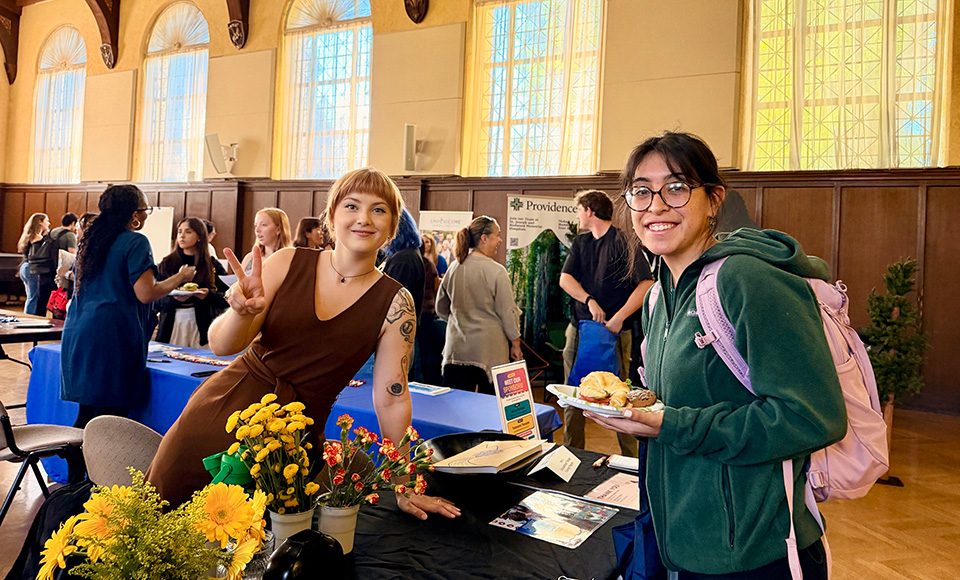
At a career fair this fall, employers and community partners from across the Bay Area came to campus to meet with Dominican University of California occupational therapy students to discuss job openings and fieldwork placements.
The event reflected the wide range of employment opportunities available to occupational therapists across healthcare, rehabilitation, and community-based services. As the region’s population ages, occupational therapists will play an increasingly important role in helping people recover from illness and injury, maintain independence and manage daily activities.
“We continue to see strong demand for occupational therapists, and we are proud of the important role Dominican plays in preparing healthcare professionals for our region,” says Dr. Gina Tucker-Roghi, associate professor, chair and program director of Dominican’s occupational therapy department.
“As the northernmost entry-level master's program in occupational therapy in California, Dominican is positioned to help meet workforce needs in the North Bay and Northern California, including rural communities and areas with limited access to healthcare services.”
Dominican offers both a Master of Science in Occupational Therapy (MSOT) and a Doctor of Occupational Therapy (OTD). The first cohort of OTD students had their degrees conferred in August. They will walk in the graduation ceremony in December and are currently preparing for their board exams.
In recent years, 90 percent of graduates from the MSOT program who reported their time to employment secured an occupational therapy position within two months of licensure. That figure rose to100 percent within four months. Among employed occupational therapists who responded to the Class of 2025 salary survey, the median annualized starting salary was $109,200.
Occupational therapists help people participate in everyday activities, maintain or regain independence, and navigate the physical, psychosocial, cognitive, and environmental challenges that can affect daily life. Dominican’s MSOT program combines graduate-level academic preparation with practical experience, professional identity development, and connections to employers across the region.
Alumni from the MSOT classes of 2021–2024 are working in healthcare organizations, rehabilitation facilities, pediatric therapy practices and school districts throughout California and across the country. Among graduates for whom employer locations were documented, 64% work in the nine-county San Francisco Bay Area, including 24% in Marin and the North Bay. Their employers include leading healthcare organizations such as Stanford Health Care, Kaiser Permanente, Sutter Health and Providence, as well as specialized rehabilitation providers and community-based practices.
“Our program also contributes to the healthcare workforce in underserved areas,” says Tucker-Roghi. “About 25% of Dominican’s occupational therapy graduates entered practice in medically underserved communities during a three-year reporting period.”
Dominican also does an exceptional job preparing academically, posting a 96 percent three-year graduation rate for the 139 members of the MSOT classes of 2023-2025. The program also recorded a 94% three-year average pass rate on the national certification exam administered by the National Board for Certification in Occupational Therapy, based on graduates who passed within one year of graduation.
Fieldwork is central to the MSOT program, which maintains relationships with more than 250 local, national and international fieldwork partners. These placements give students opportunities to apply classroom learning in professional settings and gain experience serving people across different ages, needs and stages of recovery.
“Partner settings include pediatric and school-based services, hospitals, skilled nursing facilities, post-acute rehabilitation programs, and community-based organizations,” Tucker-Roghi says.
“The range of placements reflects the breadth of occupational therapy practice, which can include helping children develop everyday skills, supporting people recovering from illness or injury, and enabling older adults to maintain independence.”