Breadcrumbs
- News
- News Archive
- Dominican Experience Leads to Dartmouth College MHA

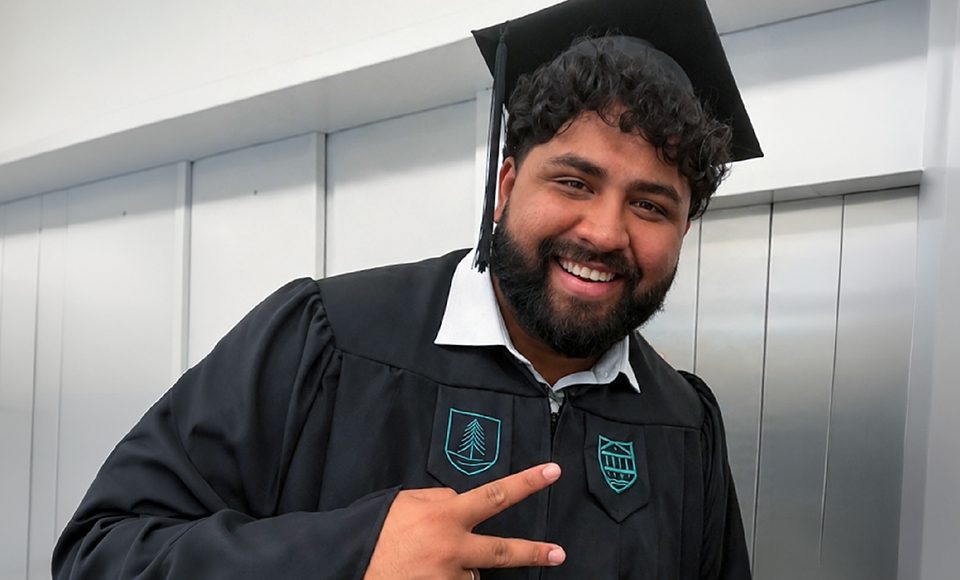
It’s been a whirlwind of a year for Azan Yousaf ’25.
He recently earned a Master of Health Administration (MHA) from Dartmouth College, building on the foundation in biology, chemistry, research, and social justice he developed as an undergraduate at Dominican.
After a quick trip back to Marin to visit family, Azan is ready for his next step: an executive director-in-training position with a health system in Washington.
The role brings Azan closer to his goal of building and leading health systems that are committed to equitable care.
“It’s a major step in my executive leadership career and aligns closely with my long-term goal of healthcare executive and CEO-level leadership,” he says.
At Dartmouth, Azan was the youngest person in his cohort and the only student to come directly from an undergraduate school. His peers included doctors, hospital executives, and other healthcare professionals. Both in the classroom and through site visits, Azan developed new expertise in healthcare finance, operations and strategy, learning to evaluate reimbursement models, and assess market dynamics.
He learned to think about healthcare at the system level while developing a better understanding of healthcare access disparities. His master’s capstone brought that perspective home to Marin. Focusing on MarinHealth, the nonprofit health system just a few miles south of his Novato hometown, Azan examined how the organization manages relationships with community organizations to improve health across the county.
Through SWOT and stakeholder analyses, Azan examined how MarinHealth coordinates its existing partnerships. His central finding: the health system may not need more community partnerships so much as a more consistent way to manage the ones it already has. A centralized approach could help clarify responsibilities, focus resources, measure progress, and ensure partnerships are responding to community needs.
The project reflects how Azan’s perspective has evolved.
At Dominican, he developed a strong scientific and clinical foundation while discovering a passion for the social and structural forces that shape healthcare. That interest was nurtured early through Dominican’s Service-Learning program, which showed Azan how systemic barriers affect real people.
A first-generation college student who attended San Marin High School, Azan knew little about the opportunities available at Dominican until a college advisor at Marin-based college-access nonprofit 10,000 Degrees suggested it might be a good fit.
It quickly proved to be. Azan arrived intending to study biology, but a first-year Service-Learning course inspired him to add a second major in social justice.
“I went into Service-Learning thinking I would just be volunteering my time, but I learned so much from the courses,” he says.
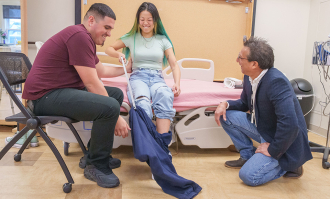
In Dominican’s Service-Learning program, community partners serve as co-educators, helping students understand the broader issues behind the work they are doing. For Azan, much of that learning took place at RotaCare, a nonprofit serving Marin residents who cannot afford primary care.
The experience exposed him to the inequities that persist even in a relatively affluent community like Marin. This helped shape his interest in becoming a healthcare advocate and leader.
“My work at RotaCare provided direct exposure to the structural and financial barriers embedded within the U.S. healthcare system, particularly for uninsured and undocumented populations,” he says.
“Witnessing the operational constraints of safety-net care sharpened my focus on designing sustainable, business-informed solutions that expand access while strengthening organizational performance.”
At Dartmouth, Azan studied health systems across the country. He saw how geography, resources, and local infrastructure can shape the way care is delivered. In some regions, for example, physician assistants and nurse practitioners play a much larger role because communities have less medical infrastructure than the Bay Area.
The experience challenged him to look beyond the clinical side of healthcare and consider how financing, insurance, policy, workforce, and organizational decisions intersect to affect patients.
“One of the biggest things I took away from graduate school is how complicated the U.S. healthcare system is,” he says. “I realize there are few simple, black-and-white solutions, and I’m particularly interested in the tension between expanding access to healthcare and maintaining the funding and incentives necessary to continue investing in innovation.”
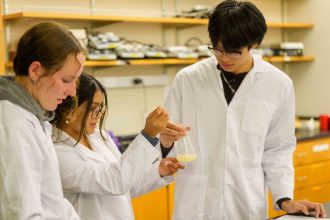
His scientific foundation began at Dominican. As a biology student, Azan participated in the University’s research methodology course sequence, gaining hands-on experience in laboratory and field research. Working with a faculty mentor, he studied the impact of fire on the long-term health of amphibians in California’s forests, learning to collect microbial samples, conduct genetic analyses and identify bacteria using DNA sequencing.
He also participated in the year-long Kaiser Pre-Med Mentor Program, which pairs students with Kaiser Permanente physicians and gives them an inside look at the day-to-day work of a doctor.
Together, those experiences gave Azan more than preparation for graduate school. They helped him connect science with service, and evidence with action.
“Dominican gave me the space to grow as both a scientist and an advocate,” he says. “I came in figuring things out while working and supporting my family, and I’m leaving with a clear sense of purpose, deep community ties, and the confidence to lead in healthcare spaces that need change.”