Breadcrumbs
- News
- News Archive
- Scholarly, Creative Works Conference Showcases Student Accomplishments

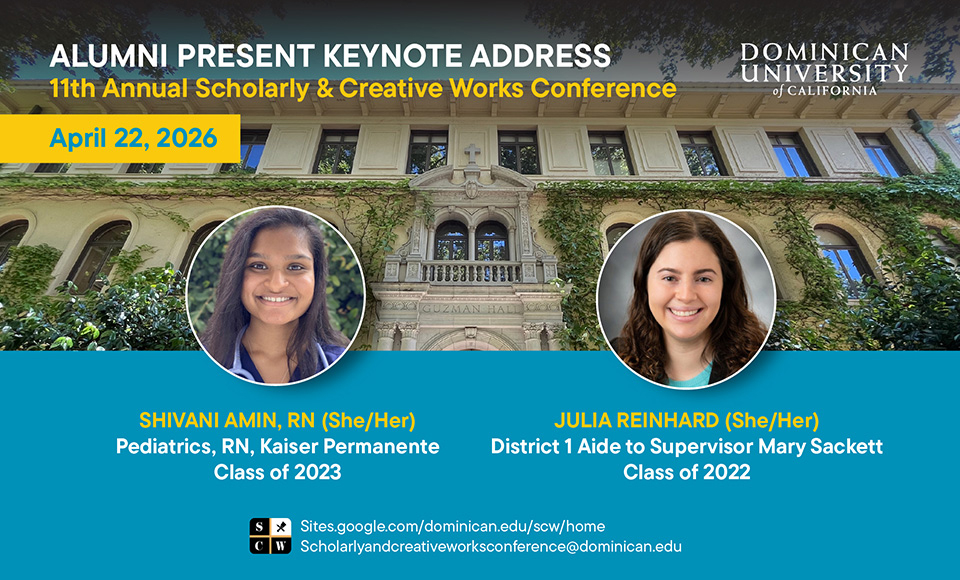
Dominican University of California held its 11th annual Scholarly and Creative Works Conference on April 22 to showcase student research, creative writing, artwork, dance, and performance. Julia Reinhard ’22 and Shivani Amin ’23 delivered the keynote address.
Here Julia and Shivani discuss how their undergraduate years helped shape their professional lives.
Julia graduated in 2022 with a Bachelor’s degree in Political Science. She now serves as a board aide to Marin County Supervisor Mary Sackett. During her time at Dominican, Julia was involved with the Dominican Political Science Association, IGNITE, and the peer mentoring program.
What research/scholarship were you involved with at Dominican?
I wrote my senior thesis about local news deserts (the lack of a newspaper in an area) and if there was any clear effect between a state’s news desert counts, voter turnout, and civic engagement.
Why do you feel participating in hands-on research and scholarship is an important part of a college career?
It’s an opportunity to practice your critical thinking skills. By diving into an academic area, you are reading others’ scholarship and learning how to craft your own thoughts into a contribution. Learning how to research is key to any job.
Tell us about your interest in public service and how your experience at Dominican helped you reach your goals.
My political science courses set the foundation for my interest in public service. During my junior year, I had an opportunity to intern in Marin County Supervisor Katie Rice’s office. Two of my peers, Allison Kustic and Katya Palacios, had held the internship prior and connected me. I appreciated on campus activities with the Dominican Political Science Association and IGNITE to engage in debates and voter registration with my peers.
What advice would you give today's Dominican students about making the most of their undergraduate or graduate experience at the University?
My advice is to not underestimate the power of your critical thinking skills as well as emotional intelligence. Whether it’s the influence of AI, or that in general humans have very short attention spans, take the time to look people in the eye and really listen to them. It’s also okay to not have an answer to everything, get comfortable with saying: I don’t know and I’ll get back to you.
Shivani graduated in 2023 with a Bachelor’s degree in Nursing. She currently works as a pediatric nurse as well as a clinical instructor in Dominican’s nursing department. During Shivani’s time at Dominican she was involved as a peer mentor, tutor, worked in the nursing simulation department, recreational hikes, nursing peer mentor, and DNSA.
What’s one specific experience at Dominican that changed how you practice as a nurse today?
At Dominican, the patient simulation scenarios really changed how I see nursing. I was so focused on doing everything “right” that I almost missed subtle signs my patient was getting worse. During the debrief with my instructors, it finally clicked that nursing isn’t just about tasks, it’s about truly noticing and thinking ahead. Since then, I’ve been more intentional about trusting my instincts, paying attention to small changes, and speaking up early to advocate for my patients.
What research did you work on at Dominican, and what did it teach you about patient care or outcomes?
During my senior year, my capstone research project focused on the impact of self-care on anxiety in Asian American breast cancer patients. Through this research, I learned how cultural factors influence how patients experience and express anxiety, as well as their willingness to seek support. It reinforced the importance of culturally sensitive care and incorporating self-care strategies, such as meditation and arts and crafts, into treatment plans to help reduce anxiety and improve patient outcomes.
Tell us about a time you worked with a vulnerable or underserved population — what did you learn that changed how you see patients?
One meaningful experience for me was doing clinicals in Marin County during COVID. I helped with testing and vaccine clinics. We saw a diverse group of patients, and many were anxious, unsure, or had limited access to reliable information. It taught me how important it is to stay calm, communicate clearly, and meet people where they are. I learned that even small things, like explaining the vaccine in simple terms or just reassuring someone who was nervous, can make a big difference in trust and outcomes.
What was the hardest part of going from student to new grad nurse, and what helped you get through it?
The hardest part of transitioning from student to new grad nurse was learning to feel confident making decisions on my own. As a student, I always had someone double-checking me, but as a new nurse, I had to start trusting my own clinical judgment while still managing a full workload. What helped me get through it was leaning on my preceptors and asking questions early instead of waiting until I felt unsure. I also reminded myself that it’s okay not to know everything right away. Over time, gaining experience and reflecting after shifts really helped me build confidence and feel more grounded in my practice.